
Understanding NDAA-Compliant Drones in 2026
When procuring a drone in 2026, specifications like flight time, camera resolution, and transmission range are no longer the only critical factors. For many organizations, the most important specification is compliance.
An NDAA-compliant drone is an aircraft that adheres to strict federal procurement restrictions outlined in the National Defense Authorization Act (NDAA) and the American Security Drone Act (ASDA). True compliance is not dictated by where the drone is assembled. Instead, it is determined by three core pillars: the manufacturer's ownership structure, the origin of critical components, and how the system's software routes data.
Failing to meet these standards can result in the loss of federal funding, revoked contracts, or grounded fleets.
The Legal Framework Driving Drone Compliance

NDAA compliance is rooted in federal law, overriding any manufacturer marketing claims or local agency policies. If your operations involve government contracts, public safety, or federal funding, you operate under this legal umbrella.
1. The National Defense Authorization Act (NDAA)
The NDAA is a sweeping annual federal law that dictates national security and defense spending. Section 848 of the FY2020 NDAA is the cornerstone of drone compliance. It originally prohibited the Department of Defense from purchasing or operating drones manufactured by foreign entities deemed to pose a national security risk.
While the FAA continues to govern airspace and operational rules, the NDAA strictly governs procurement. There is no official "NDAA-Certified" sticker; instead, compliance is a legal status achieved when a drone's hardware, software, and corporate backing are free from restricted foreign influence.
2. The American Security Drone Act (ASDA)
The ASDA (Section 1825 of the FY2024 NDAA) significantly expanded these rules. It pushed NDAA restrictions far beyond the military, applying them to all federal agencies and any programs utilizing federal funds.
Critical Point for 2026: The ASDA reached full enforcement on December 22, 2025. Any federally funded drone program that has not audited its fleet against these updated restrictions is currently operating with massive compliance exposure.
NDAA Compliance vs. Blue UAS vs. Green UAS
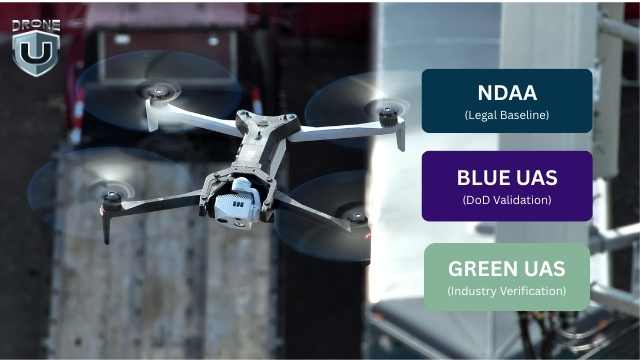
The market often confuses NDAA compliance with validation programs like Blue UAS and Green UAS. Understanding the distinctions is vital for making the right purchasing decision.
| DIMENSION | NDAA COMPLIANCE | BLUE UAS | GREEN UAS |
|---|---|---|---|
| What it is | A federal legal requirement | A DoD security validation program | An industry-led verification program |
| Who defines it | US Congress (NDAA / ASDA) | Defense Contract Management Agency (DCMA) | AUVSI (Association for Unmanned Vehicle Systems) |
| Required by Law? | Yes — for federal/funded programs | No — voluntary validation | No — voluntary validation |
| Who it applies to | All federal agencies + federally funded programs (post ASDA Dec 2025) | DoD and defense contractors primarily | Civilian, public safety, and enterprise buyers |
| What it evaluates | Manufacturer ownership, component sourcing, software/data pathways | Cybersecurity, supply chain integrity, operational risk | Cybersecurity, sourcing practices, and data handling |
| Does it prove NDAA compliance? | Yes — it is the legal standard | Partial — adds assurance, not the legal test | Partial — adds assurance, not the legal test |
| Can a drone be NDAA-compliant without it? | N/A (NDAA is the law itself) | Yes. Many compliant drones aren't on the list | Yes — verification is optional |
| Best used for | Any government or funded procurement decision | DoD contracts, defense-adjacent work | Public safety, state/local agencies, enterprise |
| Updated how often | As legislation changes (annually via NDAA cycle) | Cleared List updated by DCMA as drones are reviewed | Verified manufacturers updated by AUVSI |
Which Compliance Standard Do You Actually Need?
Your requirements depend entirely on your funding source, your organization type, and your end-use case. The following table outlines standard requirements across various sectors:
| BUYER/USE CASE | NDAA REQUIRED? | BLUE UAS NEEDED? | GREEN UAS RECOMMENDED? | KEY CONSIDERATION |
|---|---|---|---|---|
| Federal agency (direct purchase) | Yes | If DoD | Optional | ASDA fully enforced Dec 2025 — all agencies covered |
| State/local government (federal grant funded) | Yes | No | Recommended | Funding source triggers NDAA regardless of agency level. |
| State/local government (own funds) | Check funding | No | Recommended | May still apply if any federal funds are involved; best practice to comply |
| Public safety (police, fire, EMS) | Check funding | No | Recommended | Many departments receive DHS or DOJ grants that trigger NDAA |
| Federal contractor / prime contractor | Yes | Contract-specific | Optional | NDAA flows down through contract terms — verify before procurement |
| Enterprise/commercial (no federal funds) | Not required | No | Optional | No legal requirement — but increasingly a client expectation |
| Critical infrastructure operators | Check funding | No | Recommended | Energy, utilities, and telecoms face growing federal security expectations |
| Academic / research institutions | Check grants | No | Optional | Federal research grants trigger NDAA for funded portions of the program |
The 3 Pillars of NDAA Drone Compliance
To verify if a drone is legally compliant, it must pass scrutiny across three distinct system levels:
1. Manufacturer Ownership and Control
NDAA regulations expressly ban drones produced by "covered foreign entities." These are corporations that are owned, influenced, or controlled by foreign governments identified as national security threats. A drone assembled in the USA by a subsidiary of a restricted foreign parent company is not compliant. The ultimate corporate ownership dictates the status.
2. Component and Supply Chain Sourcing
Final assembly locations mask deep supply chain risks. NDAA compliance relies on where the drone's critical components—such as flight controllers, communication modules, gimbals, radios, and cameras—are sourced. If a single critical internal component comes from a restricted source, the entire system fails the compliance test.
3. Software, Firmware, and Data Pathways
In 2026, data routing is heavily audited. Compliance extends to how a drone's software is updated, where telemetry is stored, and who has access to the cloud infrastructure. If flight data or firmware updates pass through servers controlled by restricted entities, the hardware's compliance becomes void.
Payloads and System-Level Compliance
Compliance is evaluated at the system level. A fully NDAA-compliant airframe will immediately lose its compliance status if an operator attaches a restricted third-party payload. Cameras, LiDAR sensors, and communication radios must pass the exact same ownership, component, and data-flow tests as the base drone. Buyers must manage payloads as strictly as the aircraft themselves.
How to Verify Compliance Before Purchasing
Do not rely on marketing brochures. To survive an audit, follow these verification steps:
- Demand a Written Compliance Statement: Ensure the manufacturer provides formal documentation addressing ownership, component sourcing, and data infrastructure.
- Scrutinize Corporate Structure: Identify the ultimate parent company to ensure no restricted foreign control exists.
- Check Component Origins: Request clarity on where key electronics (radios, flight controllers) are manufactured.
- Map the Data Flow: Understand where flight data lives and how firmware updates are delivered.
- Look for Blue/Green UAS: Use these lists as supporting evidence, though they are not the final legal authority.
- Plan for Re-verification: Compliance can change. Treat verification as an ongoing lifecycle requirement, especially when renewing contracts or updating firmware.
Debunking Common NDAA Compliance Myths
-
Myth: "Made in the USA" guarantees compliance.
Fact: Final assembly does not negate restricted supply chains or foreign corporate ownership. -
Myth: Drones must be on the Blue UAS list to be legal.
Fact: Blue UAS is a DoD program. A drone can easily meet NDAA legal standards without ever applying for Blue UAS validation. -
Myth: Compliance is permanent.
Fact: If a manufacturer shifts suppliers or updates data routing infrastructure, a previously compliant drone can become non-compliant overnight. -
Myth: NDAA only affects the military.
Fact: Following the ASDA enforcement in December 2025, restrictions apply to all federal agencies and any state/local programs utilizing federal grant money.
The Future Landscape of Drone Procurement
Moving through 2026 and beyond, NDAA compliance is shifting from a one-time procurement hurdle to a continuous lifecycle requirement. Auditors are demanding transparent supply chains and secure software architectures over the lifespan of the drone. Forward-thinking agencies and enterprises are structuring their fleets around platforms that guarantee long-term compliance to avoid forced obsolescence and grounded operations.
Operating a compliant drone fleet ensures your business remains eligible for lucrative contracts, avoids regulatory disruptions, and maintains the highest standards of data security.
Ready to upgrade your fleet with secure, reliable, and compliant drone technology? Explore our full catalog of professional and enterprise solutions today at https://globaldroner.com/.