
I still remember the first time I witnessed a fixed-wing drone glide effortlessly over a vast agricultural field. It felt like stepping into the future. Within minutes, the lightweight aircraft mapped the entire area with pinpoint accuracy—a task that would have historically taken hours, if not days, with traditional surveying equipment.
Unlike standard quadcopters that rely on spinning rotors to hover, fixed-wing unmanned aerial vehicles (UAVs) are designed like traditional airplanes. They generate lift by moving forward. This aerodynamic design allows them to stay airborne significantly longer, fly at higher speeds, and cover massive expanses of land on a single battery charge.
In this comprehensive guide, we will explore the mechanics behind these incredible machines, compare them to traditional rotary drones, and dive into 8 of the most impressive fixed-wing drones available on the market today.
What Are Fixed-Wing Drones?
As the name implies, fixed-wing drones feature a rigid wing structure similar to a conventional airplane. Because they don't require constant downward thrust from multiple propellers to defy gravity, they use air flowing over and under their wings to stay aloft with minimal energy expenditure.
This remarkable energy efficiency means fixed-wing UAVs boast longer flight times, expansive coverage per charge, and superior cruising speeds. They are the ultimate tools for large-scale mapping, agricultural field analysis, pipeline inspections, and search-and-rescue operations. Simply put: they are built for endurance and coverage, not for hovering or cinematic close-ups.
Rotary-Wing Drones vs. Fixed-Wing UAVs
Fixed-wing UAVs and rotary-wing drones (quadcopters) are engineered for entirely different purposes. While fixed-wing models dominate long-range endurance missions, rotary drones are masters of hovering, agility, and close-range inspections.
| Feature | Fixed-Wing Drone | Rotary-Wing Drone (Quadcopter) |
|---|---|---|
| Flight Time | 60–120 minutes (Highly efficient) | 20–30 minutes (Limited by constant power draw) |
| Maneuverability | Requires forward motion; cannot hover | Can hover, rotate, and navigate tight spaces |
| Range | Long-range operations | Short-range operations |
| Speed | Fast cruising speeds | Generally slower |
| Payload Capacity | Usually high; ideal for heavy mapping gear | Moderate; restricted by power and space |
| Launch/Recovery | Requires open space (or VTOL capabilities) | Vertical takeoff/landing from almost anywhere |
| Ease of Use | Steeper learning curve | Beginner-friendly |
| Best For | Mapping, surveying, agriculture, long-range tracking | Photography, close inspections, indoor flights |
When to Choose a Fixed-Wing Drone
- You need to map massive areas like farmland, mining sites, or forests.
- Flight endurance is your top priority.
- You require consistent, high-quality data over long distances.
- You operate in open environments where takeoff and landing space is plentiful.
When to Choose a Rotary-Wing Drone
- Your mission requires hovering, circling, or flying at very low speeds.
- You are capturing cinematic video or real estate photography.
- You need to perform close-up inspections of cell towers, bridges, or roofs.
- You are flying in confined or urban environments.
The 8 Best Fixed-Wing Drones with Cameras
Whether you need a professional-grade mapping machine or a rugged, long-endurance flier, here are the top 8 fixed-wing drones dominating the skies.
1. Wingtra One Gen II
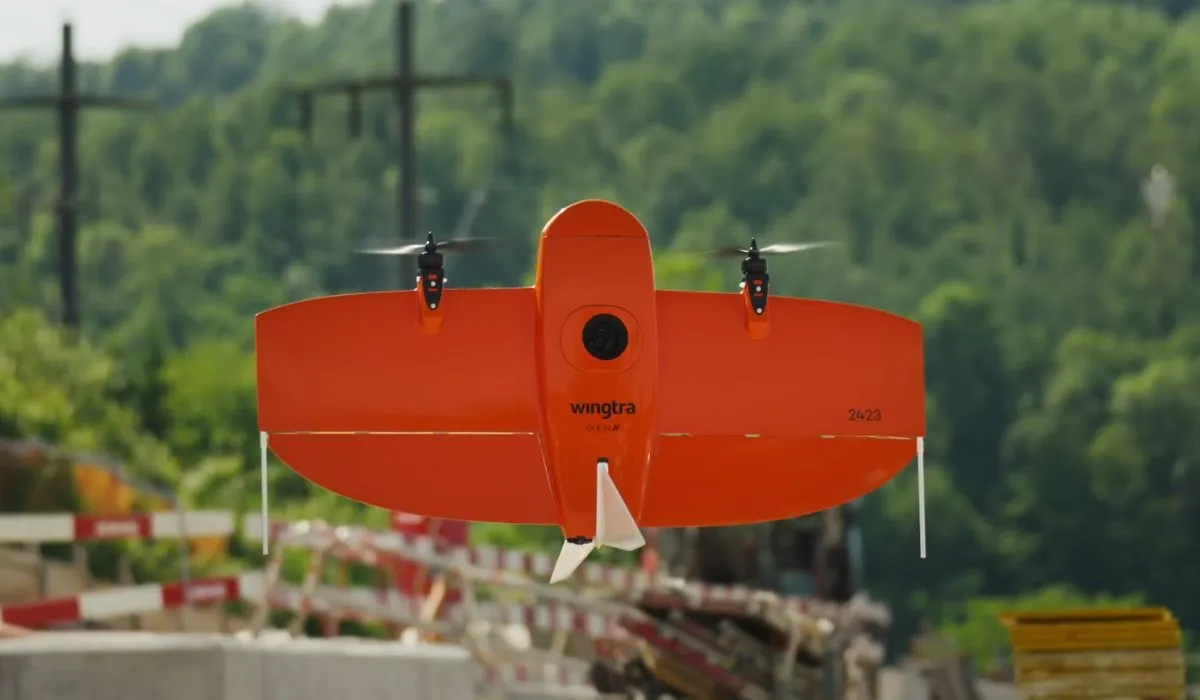
The NDAA-approved Wingtra One Gen II is an aerial mapping powerhouse. Capable of carrying a full-frame camera, this drone pairs seamlessly with Wingtra Hub software, allowing pilots to geo-tag images with obsessive PPK (Post-Processed Kinematic) precision. When combined with mapping software like Pix4D, creating geo-referenced orthomosaics is lightning-fast. It supports various payloads, including multispectral and LiDAR systems.
| Weight | 3.7 kg (8.1 lb) |
| Max. payload weight | 800 g (1.8 lb) |
| Wingspan | 125 cm (4.1 ft) |
| Battery capacity | Two 99 Wh batteries |
| Radio link | Bi-directional 10 km (6 mi) line of sight |
| Flight planning software | WingtraPilot |
| Flight speed | 16 m/s (35.8 mph) |
| Maximum flight time | Up to 59 min |
| Min. space for takeoff/landing | 2 m × 2 m (6.6 ft × 6.6 ft) |
| Temperature range | -10 to +40 °C (14 to 104 °F) |
| Transmission Distance | 10 Kilometers |
2. Trinity F90+
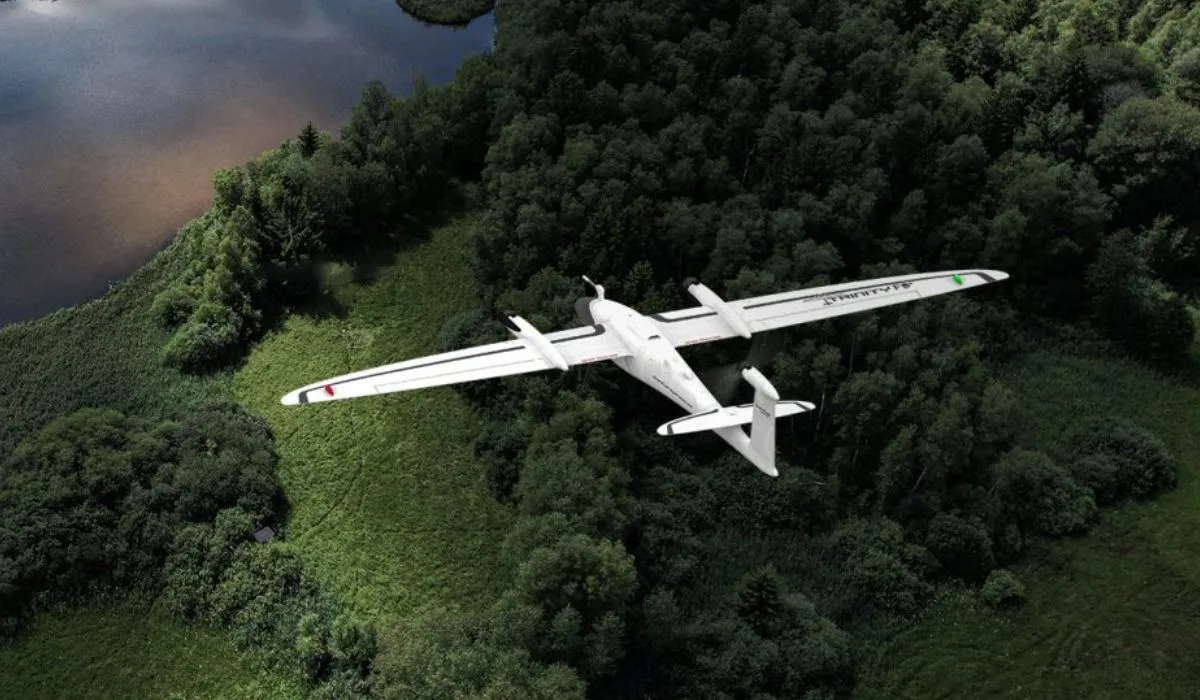
The Trinity F90+ is the marathon runner of the drone world. Boasting a flight time exceeding 90 minutes and a 15-kilometer range, it can map areas up to 20 times larger than classic multicopters. It comes equipped with PPK technology and supports RGB and multispectral dual payloads. With Live Air Traffic (ADS-B) integration and robust motors, it is the go-to choice for commercial surveyors demanding absolute reliability.
| Weight | 5.5 kg (12.13 lbs) |
| Max. payload weight | 700 g (1.5 lb) |
| Wingspan | 2.394 m (7.85 ft) |
| Battery capacity | Two 100 Wh batteries |
| Flight planning software | QBase 3D |
| Flight speed | 17 m/s |
| Wind resistance | Sustained: 12 m/s | Gusts: 18 m/s |
| Maximum flight time | 90 min |
| Min. space for takeoff/landing | 3 m × 3 m (9.8 ft × 9.8 ft) |
| Temperature range | -12 °C to 50 °C (10.4 °F to 122 °F) |
3. JOUAV CW-25E
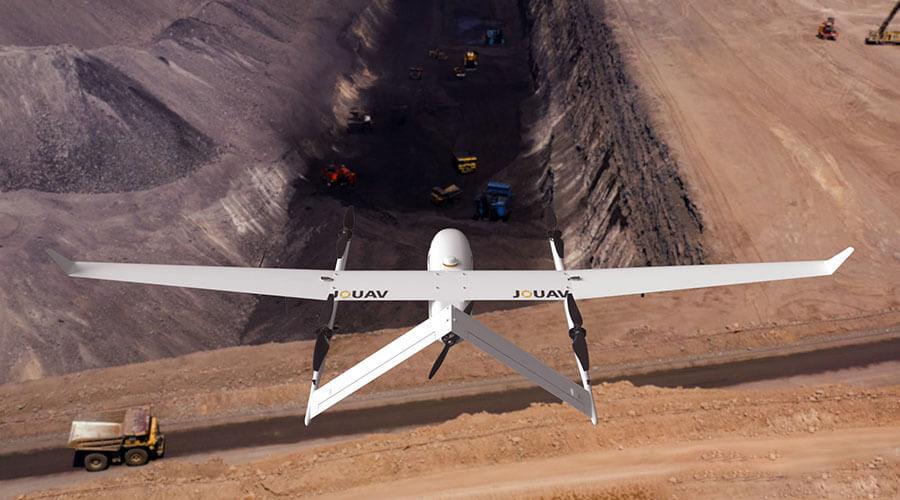
Known for its incredible versatility, the JOUAV CW-25E is an electric fixed-wing VTOL (Vertical Takeoff and Landing) drone built for extremes. Depending on the payload, it delivers a staggering 150 to 210 minutes of flight time. With a service ceiling of 6,000 meters, it thrives in high-altitude environments, making it ideal for mountainous search-and-rescue or advanced meteorological data collection.
| Max Flight Time | 210 minutes |
| Cruising Speed | 70 km/h |
| Max Service Ceiling | 6000 m |
| Max Payload | 6 kg |
| GPS / Auto-Return | Yes / Yes |
| Anti-vibration Capability | Yes |
4. SenseFly eBee X
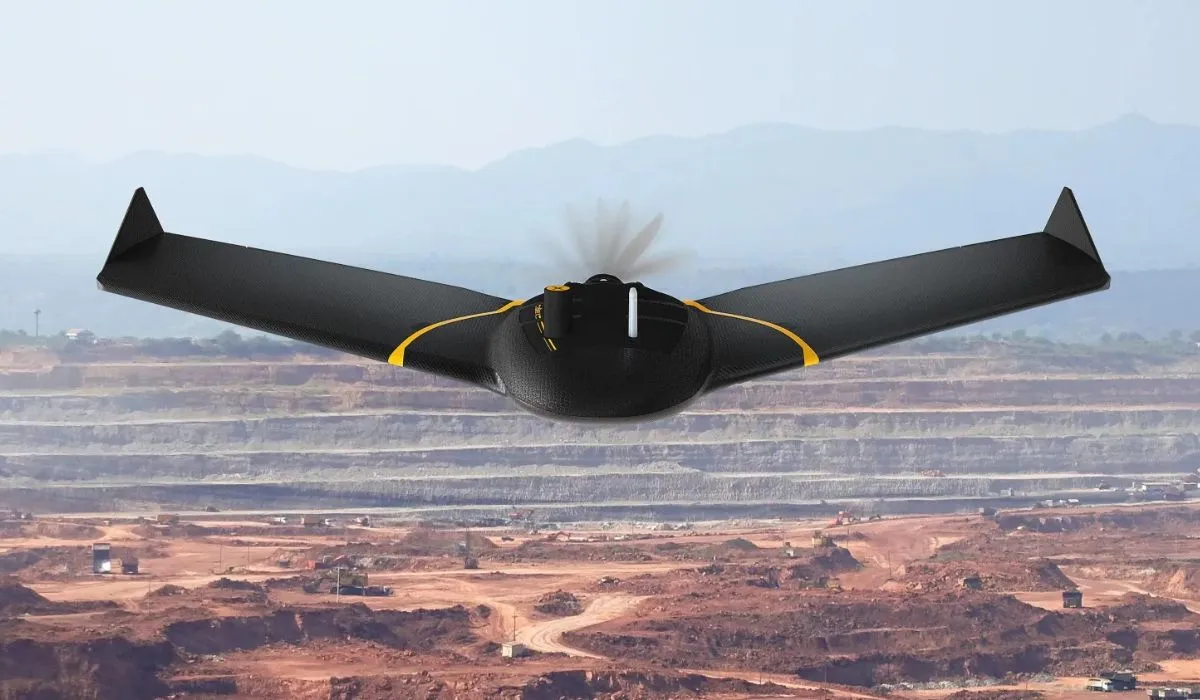
An absolute legend in agricultural mapping, the NDAA-approved SenseFly eBee X remains a highly popular choice for professionals. Offering six different payload options and an Endurance Extension that pushes flight times to 90 minutes, it can cover up to 1,235 acres in a single flight. With RTK activation, it achieves 3-centimeter accuracy without the need for Ground Control Points.
| Weight | 2.3 kg (5.07 lb) |
| Max. payload weight | 1.4 kg (3.09 lb) |
| Wingspan | 1.68 m (5.51 ft) |
| Battery capacity | Two 80 Wh batteries |
| Flight planning software | eMotion 3 |
| Flight speed | 18 m/s (37.8 mph) |
| Maximum flight time | Up to 90 min |
| Min. space for takeoff/landing | 10 m × 10 m (33 ft × 33 ft) |
| Temperature range | -10 °C to +40 °C (14 °F to 104 °F) |
5. Autel Dragonfish Pro
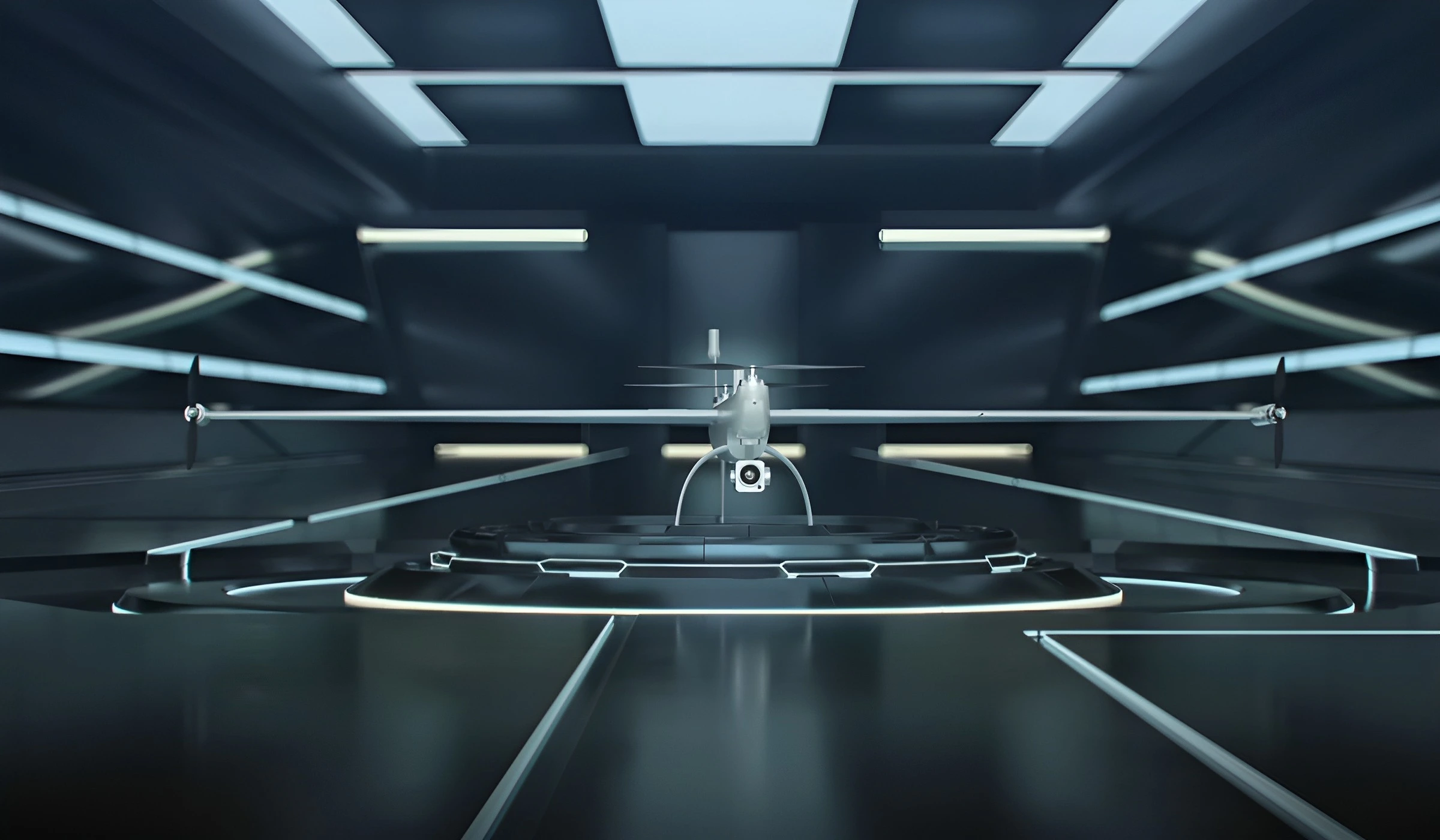
The Autel Dragonfish Pro redefines aerial endurance with a jaw-dropping 158-minute flight time and a 15-kilometer transmission range. What truly sets it apart is its VTOL tilt-rotor design, which allows it to be flown manually like a standard quadcopter or autonomously for complex missions. Modular, waterproof, and equipped with AI tracking capabilities, it is mission-ready straight out of the box.
| Weight | 8.5 kg (18.7 lbs) |
| Max. payload weight | 1.8 kg (4 lbs) |
| Wingspan | 1.6 m (5.25 ft) |
| Battery capacity | Four 174 Wh batteries |
| Radio link | 30 km (18.6 mi) line of sight |
| Flight planning software | Autel Voyager |
| Flight speed | 108 km/h (67 mph) |
| Maximum flight time | 180 min (Total capacity) |
| Min. space for takeoff/landing | 3 m × 3 m (9.8 ft × 9.8 ft) |
| Temperature range | -20 to +50 °C (-4 to +122 °F) |
6. Bramor C4EYE
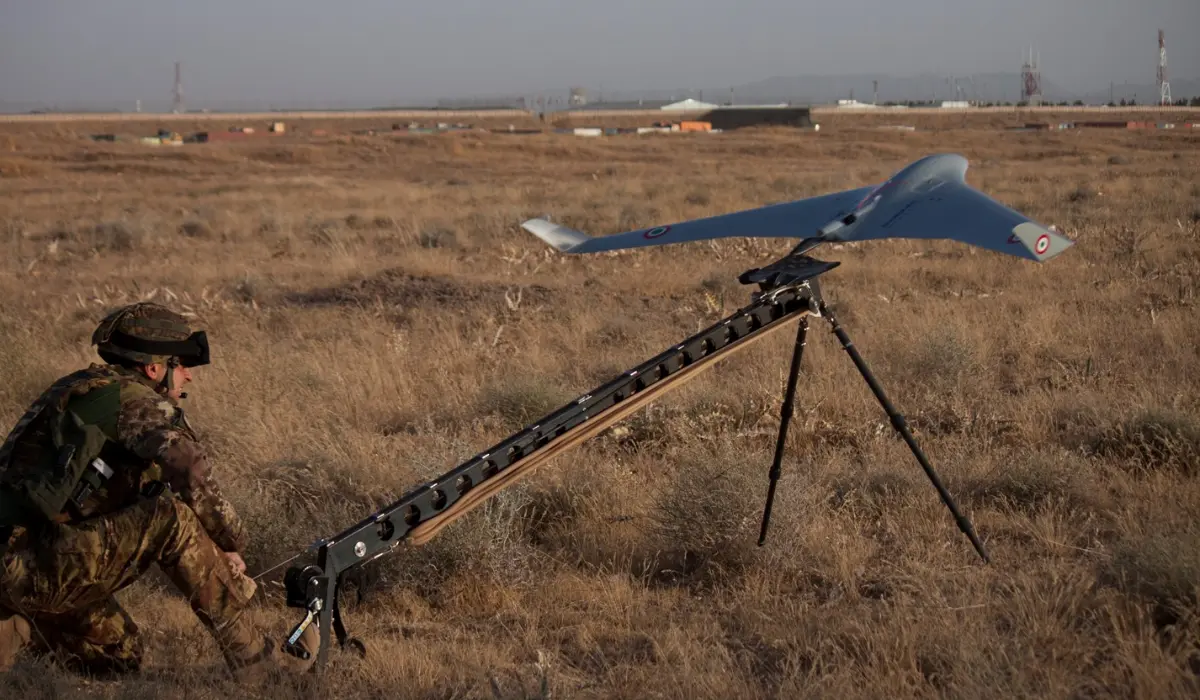
If endurance is your ultimate metric, C-Astral’s Bramor C4EYE reigns supreme. Utilizing advanced Blended Wing Body aerodynamics, this electrically powered drone can stay aloft for an astonishing 3.5 hours. It supports advanced digital, thermal, and IR payload combinations, making it the crown jewel for heavy-duty surveillance, mapping, and monitoring missions.
| Weight | 4.7 kg (10 lb) |
| Max. payload weight | 1 kg (2.2 lb) |
| Wingspan | 2.3 m (7.7 ft) |
| Battery capacity | Two 93 Wh batteries |
| Radio link | 40 km (25 mi) standard; 150 km extended |
| Flight planning software | Bramor GCS |
| Flight speed | 20 m/s (45 mph) |
| Wind resistance | 30 knots (35 mph) |
| Maximum flight time | 3.5 hours |
| Min. space for takeoff/landing | 2 m × 2 m (6.6 ft × 6.6 ft) |
7. Delair UX11
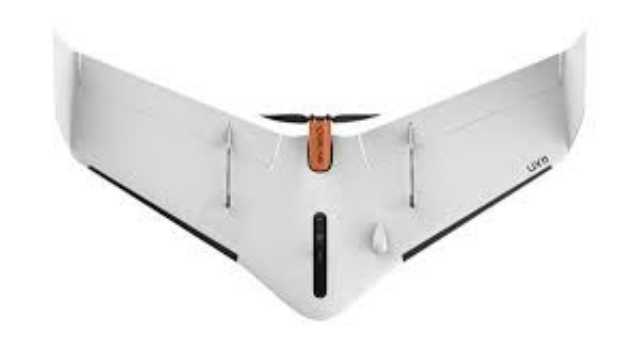
The Delair UX11 is a highly respected tool in the commercial mapping industry. Built specifically for professional photogrammetry and geospatial data capture, the UX11 delivers up to 80 minutes of endurance. With robust 3G/4G cellular connectivity, it seamlessly handles Beyond Visual Line of Sight (BVLOS) operations where permitted, making it highly productive for construction and GIS projects.
| Weight (With payload) | 1.6 kg (3.5 lb) |
| Wingspan | 1.2 m |
| Maximum flight time | Up to 80 minutes |
| Cruise speed | 54 km/h (34 mph) |
| Coverage per flight | 300+ acres (120+ ha) |
| Camera payload | Integrated high-res RGB & PPK GNSS |
| Launch & recovery | Hand-launch / belly landing |
| Connectivity | Radio + 3G/4G cellular |
8. Boeing ScanEagle
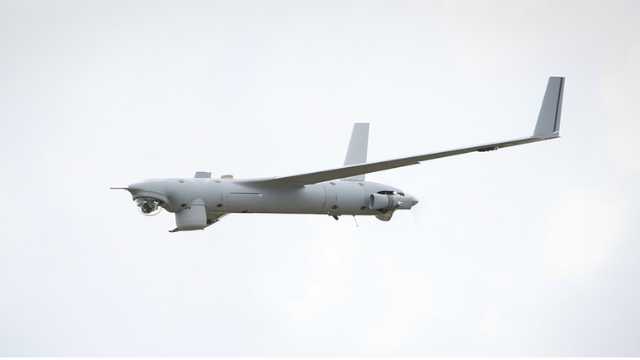
The Boeing ScanEagle sits in a class of its own. It is a proven, military-grade aerial system designed for persistence. Instead of batteries, it relies on a gas-powered propulsion system that keeps it airborne for an incredible 18+ hours. Because it uses a pneumatic catapult for launch and a SkyHook system for recovery, it requires zero runway space, allowing it to operate from ships or remote outposts.
| Weight | 28 kg (62 lb) |
| Maximum payload weight | 8 kg (17 lb) |
| Wingspan | 3.1 m (10.2 ft) |
| Propulsion | Gas-powered |
| Radio Link | Long-range encrypted datalink |
| Camera payloads | EO/IR, stabilized ISR sensors |
| Maximum flight time | 18+ hours |
| Launch method | Pneumatic catapult |
| Recovery method | SkyHook system |
| Best for | ISR, surveillance, maritime patrol |
How Does a Fixed-Wing Drone Work?
Fixed-wing drones operate using the same foundational aerodynamic principles as airplanes: lift, thrust, and forward motion.
Step 1: Lift
As the drone moves forward, the unique curvature of its wings causes air to flow faster over the top and slower underneath. This creates a pressure differential that literally pulls the drone upward, allowing it to glide efficiently without relying on downward propeller thrust.
Step 2: Thrust
These drones typically feature a single motor with a propeller mounted at the front (puller) or the back (pusher). This motor generates thrust to push the aircraft forward. Once cruising speed is achieved, the wings take over the heavy lifting.
Step 3: Control Systems
Fixed-wing UAVs offer multiple flight modes:
- Manual Mode: The pilot controls pitch, roll, yaw, and throttle. Best for highly experienced flyers.
- Stabilized Mode: The drone’s onboard computer assists with leveling and prevents stalling, though the pilot maintains directional control.
- Autonomous Mode: The industry standard for mapping. The pilot pre-programs a grid path using software, and the drone handles the takeoff, data collection, and landing entirely on its own.
Benefits of Fixed-Wing Drones
1. Longer Flight Times
Because they glide rather than fight gravity every second, fixed-wing drones can easily achieve 60 to 120 minutes of flight on a single charge—more than triple the endurance of standard quadcopters.
2. Greater Range and Speed
Their aerodynamic profiles allow them to cut through the air swiftly. While rotary drones cruise at 15–20 mph, fixed-wing models easily surpass 40–50 mph, covering massive territories quickly.
3. Higher Energy Efficiency
Forward flight requires significantly less battery power than hovering, making these platforms highly efficient for scanning linear infrastructure like pipelines, power lines, and highways.
4. Ideal for Large-Area Mapping
Thanks to their smooth flight paths and consistent altitude hold, fixed-wing drones capture pristine imagery perfect for creating highly accurate 3D models and orthomosaics over hundreds of acres.
Limitations of Fixed-Wing Drones
1. No Hovering Ability
Because they must maintain forward momentum to generate lift, they cannot stop mid-air to inspect a specific point of interest. For close-up inspections, a quadcopter remains superior.
2. Space Requirements
Unless you are using a VTOL (Vertical Takeoff and Landing) model, standard fixed-wing drones require a runway, an open field for belly landings, or specialized catapult systems.
3. Higher Upfront Cost
Commercial-grade fixed-wing systems are substantial investments, often significantly more expensive than enterprise quadcopters. However, for professionals, the ROI realized through massive time savings makes it worthwhile.
4. Steeper Learning Curve
Piloting an aircraft that cannot simply stop and hover requires a deeper understanding of aerodynamics, wind patterns, and mission planning.
Conclusion
Fixed-wing drones are highly specialized, purpose-built tools. They aren't designed to replace quadcopters; rather, they solve the distinct challenge of covering enormous areas efficiently and reliably. If your operations involve large-scale surveying, agriculture, mapping, or persistent monitoring, integrating a fixed-wing drone into your fleet will drastically reduce battery swaps, streamline your workflow, and elevate your data collection capabilities.
Ready to explore the best drone equipment for your next mission? Visit https://globaldroner.com/ to find the perfect UAV solutions to elevate your aerial operations.