
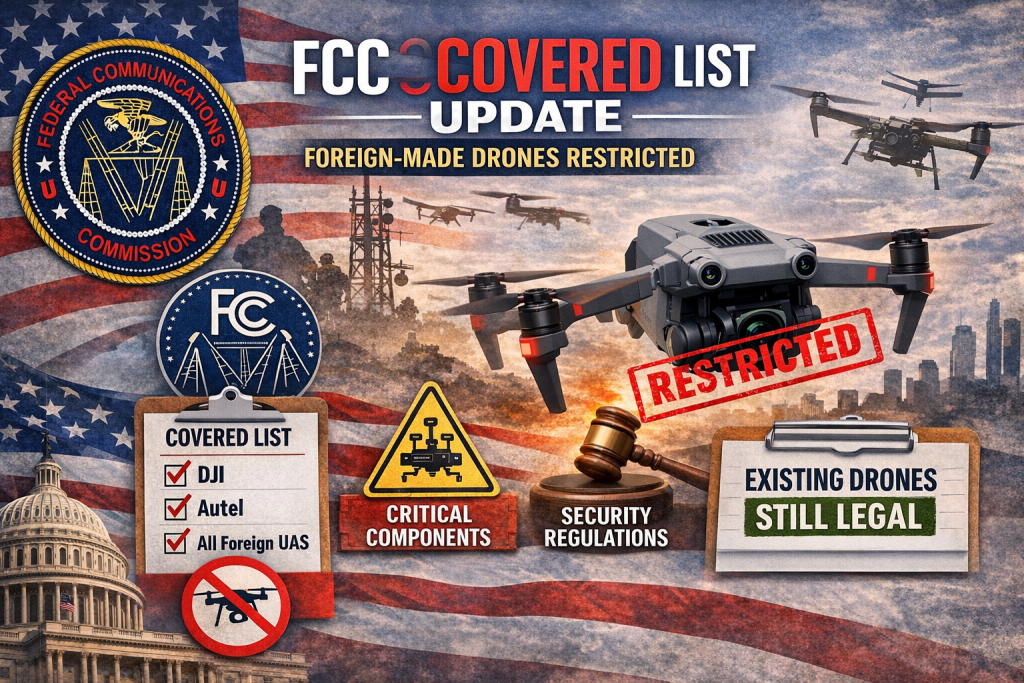
Understanding the FCC Covered List and the Future of Foreign-Made Drones
The landscape of the drone industry experienced a massive shift in December 2025. If you are a drone pilot, manufacturer, or enthusiast, understanding the Federal Communications Commission (FCC) Covered List is no longer optional—it is a necessity. Recent regulatory changes have sparked widespread confusion about what is banned, what is legal, and how the supply chain will adapt moving forward.
At its core, the new law fundamentally alters the future of drone authorizations in the United States, targeting foreign-made uncrewed aircraft systems (UAS) and their critical components. However, the legislation is nuanced, and it is crucial to separate rumor from regulatory reality.
The Crucial Role of FCC Equipment Authorization
Every modern drone relies on wireless radio transmitters to communicate with its controller. In the United States, any device transmitting radio signals must receive FCC equipment authorization before it can be legally marketed, sold, or operated.
To secure this authorization (typically under 47 CFR Part 15), manufacturers are required to certify that their company is not on the FCC’s Covered List (as per 47 CFR § 2.911). Historically, major foreign manufacturers successfully navigated this process. Once the FCC grants authorization, the equipment can be legally sold and flown by end-users.
The critical bottleneck is this: If an entity is placed on the Covered List, the FCC is legally barred from issuing new equipment authorizations (47 CFR § 2.903(a)).
The Legal Timeline: How We Reached the Current Restrictions
The current restrictions did not happen overnight. They are the result of years of escalating legislative actions aimed at national security:
- 2019: Congress passed the Secure and Trusted Communications Networks Act, establishing the foundation of the FCC Covered List.
- 2024: The National Defense Authorization Act (NDAA) for FY2025 specifically targeted major foreign manufacturers, mandating their addition to the Covered List unless cleared by a national security agency.
- December 21, 2025: An Executive Branch interagency body issued a sweeping National Security Determination that classified all foreign-made uncrewed aircraft and their critical components as national security risks.
- December 22, 2025: Acting on the determination, the FCC officially added foreign-produced UAS and their critical components to the Covered List.
Defining the Scope: What Exactly is Covered?
The language used in the December 2025 ruling is intentionally broad to prevent loopholes. The FCC adopted definitions that cover not just the drones themselves, but the entire ecosystem that makes them fly.
- Uncrewed Aircraft (UA / UAS): Any aircraft operated without the possibility of direct human intervention from within or on the aircraft.
- Uncrewed Aircraft System (UAS): The aircraft itself, alongside all associated elements required for operation, including ground stations, communication links, and external control components.
- UAS Critical Components: An explicitly open-ended list that includes data transmission devices, communication systems, flight controllers, ground control stations, navigation systems, sensors, cameras, batteries, battery management systems, motors, and any associated software.
Because this marks the first time the FCC has blanket-banned an entire category of equipment rather than specific companies, it represents a historic regulatory barrier for future imports and approvals.
Practical Implications for Pilots, Buyers, and Manufacturers
Despite the severe restrictions on future approvals, this legislation is not a retroactive drone usage ban. It is a forward-looking supply chain restriction.
If you currently own a foreign-made drone, or are looking to purchase one that has already been imported and authorized, you are legally protected. The FCC has explicitly stated that consumers can continue to buy, sell, and fly drones that have already lawfully acquired an active FCC ID. The ruling solely targets future equipment authorizations. (Note, however, that the FCC does retain the independent authority to revoke existing authorizations in the future, meaning some level of long-term risk remains).
For manufacturers and importers, the landscape is incredibly perilous. Attempting to import foreign-made drones that do not have existing FCC authorization is now strictly prohibited. Furthermore, this law does not grant exemptions based on drone size—even small toy drones are subject to these rules.
Interestingly, this law also impacts domestic manufacturers. Because the Covered List includes "Critical Components" and software, a US-based drone manufacturer utilizing foreign-made motors, flight controllers, or transmission software could find their final product barred from FCC authorization.
Navigating the Future of Drone Flight
The expansion of the FCC Covered List represents one of the most consequential regulatory shifts in the history of the US drone industry. While existing fleets remain airborne and legal, the barriers to entry for future foreign-made technology are now massive. Operators, commercial fleets, and enterprise programs must begin auditing their supply chains and planning for a market that looks vastly different than it did just a few years ago.
Looking for reliable, high-quality drones and accessories to keep your operations flying smoothly? Explore our expertly curated selection at Global Droner.