
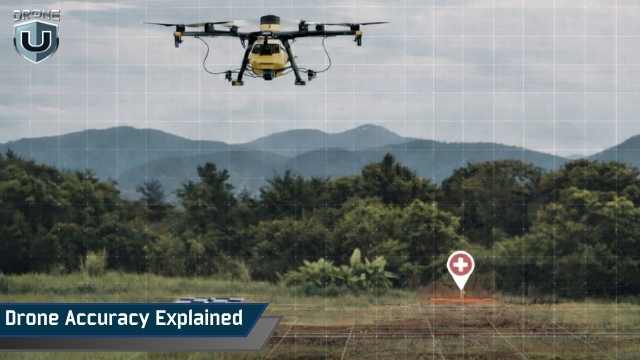
Have you ever wondered why drone mapping data that looks visually flawless still fails alignment checks, elevation comparisons, or client reviews? Today, drones capture higher-resolution imagery and record better positioning data than ever before. Yet, professionals still encounter misaligned maps and unreliable elevations.
The core issue is that drone accuracy isn't simply a switch you flip on your controller. It is a calculated outcome determined by flight design, processing settings, and validation against real-world coordinates. When these factors don't align, even the most expensive, high-precision equipment can produce faulty data. In this guide, we will break down the differences between GPS, RTK, and PPK, and explain how to achieve and prove true drone accuracy.
Understanding Standard GPS, RTK, and PPK
To understand drone accuracy, you first need to understand the three primary positioning systems used in the industry today.
- Standard GPS: Provides a positioning accuracy of 1 to 3 meters horizontally and 2 to 5 meters vertically. It relies entirely on standard satellite signals without any correction data. This is suitable for basic photography and visual inspections, but not for professional, survey-grade mapping.
- RTK (Real-Time Kinematic): RTK applies GNSS correction data to the drone during the flight via a live link to a base station or NTRIP network. It can achieve 1 to 3 cm horizontal and 2 to 5 cm vertical accuracy. While corrections happen instantly, RTK is highly sensitive to signal dropouts and weak satellite geometry.
- PPK (Post-Processed Kinematic): PPK logs raw GNSS data during the mission and applies the correction data after landing using base station logs. It delivers the same high accuracy as RTK (1–3 cm horizontal, 2–5 cm vertical) but is much more resilient to signal interruptions, making it ideal for large or obstructed sites.
The Key Takeaway: High-end positioning like RTK or PPK only improves your drone's starting position. Final accuracy is the result of your entire workflow—from image overlap to independent checkpoint validation.
GPS vs RTK vs PPK: Comprehensive Comparison Table
| Dimension | Standard GPS | RTK (Real-Time Kinematic) | PPK (Post-Processed Kinematic) |
|---|---|---|---|
| Horizontal Accuracy | 1 to 3 m | 1 to 3 cm | 1 to 3 cm |
| Vertical Accuracy | 2 to 5 m | 2 to 5 cm | 2 to 5 cm |
| Correction Timing | None | Real-time, during flight | Post-flight, during processing |
| Signal Dependency | None required | Continuous live link needed | No live link. Logs raw data |
| Signal Dropout Resilience | N/A | Vulnerable — fix can be lost | High — corrected in post |
| Base Station Required | No | Yes (or NTRIP network) | Yes (logs synced after flight) |
| GCPs Still Needed? | Yes, always | Recommended for validation | Recommended for validation |
| Best For | Visual inspection, basic photography | Construction, corridor, real-time QC | Remote sites, large areas, GIS deliverables |
| Typical Workflow Risk | High drift and offset | Fix status overconfidence | Base log sync errors |
| Guarantees Accuracy? | No | No. Validation is still required. | No. Validation is still required. |
Relative Accuracy vs. Absolute Accuracy
Not all accuracy is created equal. Knowing the difference between relative and absolute accuracy dictates how you plan, capture, and validate your drone data.
Relative Accuracy
This measures how internally consistent your dataset is. It ensures that the distances, volumes, and areas measured between points within your map are correct relative to one another. This is crucial for cut-and-fill calculations, stockpile volumes, or repetitive visual inspections. A map can have excellent relative accuracy even if it is shifted away from its true global coordinates.
Absolute Accuracy
Absolute accuracy dictates how perfectly your map aligns with the real-world Earth coordinates (latitude, longitude, and elevation). If you need your drone map to cleanly overlay onto existing survey data, legal property boundaries, or global GIS layers, absolute accuracy is non-negotiable.
Horizontal vs. Vertical Accuracy: The Elevation Challenge
When people talk about drone accuracy, they usually focus on horizontal (X and Y) positioning. However, in professional mapping and inspections, vertical (Z) accuracy is significantly harder to master.
Horizontal accuracy ensures roads and building footprints line up properly, which is relatively well-handled by modern GNSS receivers. Vertical accuracy, however, directly affects 3D surface models and volumetric calculations. Small elevation errors compound rapidly. A map that looks perfectly aligned from a top-down view might be tilted or floating inches above reality.
To improve vertical accuracy, you must:
- Maintain consistent flight altitudes and avoid abrupt angle changes.
- Increase image overlap, particularly over varying terrain and slopes.
- Place independent validation checkpoints at both flat and elevated locations.
Where Does True Accuracy Come From?
It is a common misconception that buying an RTK or PPK drone automatically buys you accuracy. In reality, hardware is just one piece of the puzzle. True accuracy is generated by:
- Flight Geometry: Straight, evenly spaced grid lines with consistent altitudes allow photogrammetry software to stitch images properly.
- Image Overlap: Robust front-to-back and side-to-side overlap prevents gaps and ties the visual data together tightly.
- Camera Settings: Eliminating motion blur through proper shutter speeds and understanding lens distortion is vital. A blurry image ruins accuracy regardless of how good the GPS data is.
- The Processing Workflow: How you process the data, align the images, and utilize control points ultimately dictates the final output.
Why RTK and PPK Data Can Still Fail
Even with high-end correction data, professionals often fail accuracy checks. Here is why:
- Project Drift: While RTK/PPK pinpoints the camera location, small errors can accumulate across large sites, causing the edges of the map to drift from real-world coordinates.
- Satellite Geometry: Partial sky obstructions or low satellite counts degrade correction quality. RTK is particularly vulnerable here since it requires a live link.
- Overconfidence in "Fix" Status: Seeing a "Fixed" status on your controller simply means corrections are being applied. It does not magically guarantee that the resulting photogrammetry will be mathematically accurate.
Ground Control Points (GCPs) vs. Checkpoints
Confusing GCPs with Checkpoints is the fastest way to generate false confidence in your data.
Ground Control Points (GCPs) are used to anchor the map. You feed them into your processing software to tell the map exactly where to sit in the real world. Because they actively force the software to adjust the map, they cannot be used to prove accuracy.
Checkpoints, on the other hand, are strictly for validation. They are measured points on the ground that you do NOT feed into the processing software. Once the map is built, you compare the map's coordinates to the physical checkpoints. If the map hits the checkpoints, you have proven absolute accuracy.
Interpreting Accuracy Reports Correctly
Photogrammetry software will generate impressive-looking accuracy reports filled with charts and RMS (Root Mean Square) error values. Be careful: a low RMS error on your GCPs only proves that the software successfully warped the map to fit the points you gave it. It is a measure of internal compliance, not real-world truth.
The only metric that truly proves your map's accuracy to a client or stakeholder is the variance measured against independent, un-processed Checkpoints.
Conclusion
Drone accuracy is not a feature you purchase; it is a meticulous process you design, execute, and validate. RTK and PPK systems are incredible tools that drastically reduce uncertainty, but they do not replace the need for strategic flight planning, proper overlap, and rigorous checkpoint validation. By focusing on your complete workflow, you ensure that your data is not just visually appealing, but mathematically defensible.
Equip yourself with the best drones and accessories for your next high-precision mission at https://globaldroner.com/.