
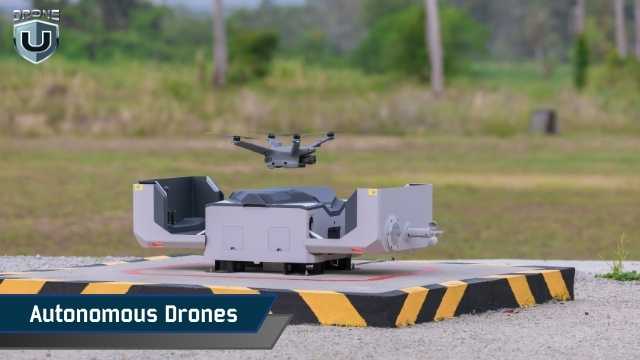
Are autonomous drones actually flying completely on their own? While fully independent drones are often discussed as if they are already a widespread reality, the practical truth is much more nuanced. Today, some drones can launch, navigate, inspect, and land with minimal human input, yet many platforms labeled as "autonomous" still require significant human oversight.
Understanding the current state of drone autonomy is crucial because it dictates how drone operations scale, their overall reliability, and where they can be legally and safely deployed. The ultimate promise is clear: fewer manual interventions, faster mission execution, and drastically lower operating costs. But can today’s systems truly deliver that level of independence outside of strictly controlled environments?
Below, we dive into how autonomous drones function today, where they deliver genuine value, the hurdles they still face, and how close the industry actually is to achieving full, scalable autonomy.
What "Autonomy" Really Means in the Drone Industry
When discussing autonomous drones, people are often referring to vastly different capabilities. The biggest point of confusion lies in the difference between automation and autonomy.
Many drones are simply automated. They follow pre-defined flight plans, scripts, or rules created by human operators. Flying a waypoint mission, mapping a corridor, or executing a scheduled inspection are examples of automation. The drone performs the task perfectly, but it lacks the ability to meaningfully interpret or reason with its environment.
True autonomy takes this a massive step further. An autonomous drone can sense its surroundings and react in real-time without human intervention. It can actively avoid unexpected obstacles, alter its flight path based on terrain changes, or halt a mission if weather conditions suddenly deteriorate. This requires robust onboard sensors, processing power, and intelligent control systems.
The Evolution of Autonomous Flight
The journey to autonomy didn't happen overnight. It has been a steady evolution of technology:
- Manual Control: Early drones were simply flying cameras requiring 100% real-time human control. If the radio signal dropped, the mission was over.
- Basic Automation: The integration of GPS introduced fundamental autopilot features, such as position holding and automatic "return-to-home" functions.
- Pre-Planned Routing: Advancements in computing allowed drones to execute waypoint missions and utilize basic obstacle sensors to stop when an object blocked their path.
- Modern Autonomy: Today's cutting-edge drones process data directly on the aircraft (edge computing). They leverage advanced AI models and sensor fusion to interpret environments and adjust their actions on the fly.
The Spectrum of Drone Autonomy
Autonomy is not a simple "on/off" switch. It exists on a spectrum, balancing operational flexibility with safety and reliability. While universal standards are still being defined, drone autonomy generally falls into these four levels:
Level 1: Human-Controlled
Every aspect of the flight is managed by a pilot in real-time. This provides high flexibility but is impossible to scale efficiently.
Level 2: Automated
The drone follows pre-planned routes for repeatable tasks like surveying. It reduces the pilot's workload but relies entirely on predictable conditions.
Level 3: Conditionally Autonomous
The drone senses its environment and can make limited flight adjustments, such as dodging obstacles. However, it operates within expected parameters and struggles with highly ambiguous edge cases.
Level 4: Fully Autonomous
The drone can independently plan missions, interpret complex environments, and complete objectives with zero external input. Currently, this is exceedingly rare and restricted to tightly controlled settings.
The Mechanics Behind Autonomous Drones
To operate independently, modern drones rely on a sophisticated triad of technologies:
1. Sensing & Perception
Drones use a combination of cameras, LiDAR, radar, and infrared sensors to map terrain and detect objects. Advanced systems utilize "sensor fusion," combining data from multiple sensors to create a highly accurate, real-time 3D map of the environment, even in low light or poor weather.
2. Decision Engines & AI
Sensors gather the data, but AI makes sense of it. Onboard decision engines analyze sensor inputs to choose optimal flight paths and react to dynamic changes. Some utilize machine learning to predict environmental movements—like anticipating a vehicle crossing the drone's path.
3. Edge Computing
For a drone to be truly autonomous, it cannot wait for a cloud server to process data. Edge computing allows the drone to process complex AI algorithms onboard. This eliminates latency and allows the drone to operate in remote areas with zero internet connectivity.
Where Autonomy is Succeeding Today
Depending on the industry, the application of drone autonomy looks very different:
- Defense & Security: The military leads the way in autonomous deployment, utilizing drones for surveillance and tactical missions with minimal input, often operating in swarms within managed environments.
- Commercial & Industrial: The energy and construction sectors heavily rely on Level 2 and 3 autonomy for routine pipeline, powerline, and structural inspections, prioritizing consistency and cost reduction.
- Emergency Response: Search-and-rescue teams use autonomous flight paths combined with thermal imaging to scan disaster zones rapidly, though humans still make the final critical decisions.
- Logistics & Delivery: Delivery remains one of the toughest sectors to fully automate. While "drone-in-a-box" systems can launch and land autonomously, navigating public airspace safely still requires strict human monitoring due to complex variables.
- Agriculture: Autonomous drones successfully manage highly routine tasks like crop mapping and targeted spraying, dynamically adjusting to terrain changes along set routes.
The Regulatory and Safety Roadblocks
Technology is only half the battle; scaling autonomous drones requires overcoming massive regulatory and safety hurdles.
Flying Beyond Visual Line of Sight (BVLOS) is critical for true autonomy. Aviation authorities (like the FAA and EASA) require bulletproof detect-and-avoid (DAA) systems, Remote ID compliance, and rigorous fail-safes before granting approvals. Furthermore, the industry must win public trust. A single safety incident in an urban environment can set back autonomous delivery programs for years, making transparency and redundant safety mechanisms absolute necessities.
What is Holding Back 100% Autonomy?
Despite rapid technological leaps, true Level 4 autonomy faces several persistent roadblocks:
- Technical Limitations: Navigating unpredictable, dynamic urban environments safely is incredibly difficult. Additionally, the heavy processing power required for AI drains battery life, limiting payload capacity and flight times.
- Security Concerns: Advanced autonomous capabilities raise valid concerns regarding privacy, data protection, and the potential misuse of dual-use technologies.
- Airspace Integration: Autonomous drones must seamlessly share the sky with traditional aircraft, helicopters, and other drones. Creating a reliable, unified traffic management system is an ongoing global challenge.
Looking Ahead
Autonomous drones have bridged the gap between science fiction and industrial reality. While fully independent, unsupervised flights in complex urban environments remain a challenge for the future, conditional autonomy is already revolutionizing agriculture, infrastructure, and defense.
As AI, sensor miniaturization, and edge computing continue to advance, the gap between automation and true autonomy will continue to close, unlocking the skies for a new era of aerial innovation.
Ready to elevate your aerial operations? Discover the latest in cutting-edge drone technology, parts, and professional accessories at Global Droner.